Yes. Joseph Smith issued the order as mayor after the city council authorized removal. The press and type were destroyed on June 10, 1844. The council called the establishment a public nuisance and feared unrest. Counterfeiting allegations are part of the record, but do not by themselves establish the decisive motive. A faithful response should acknowledge Joseph’s responsibility and assess the action directly.
Questions that test the framework
Which document establishes the action, and which supports the proposed motive?
Are we discussing an allegation, its truth, the order’s rationale, or its legal and moral justification?
What evidence distinguishes competing or combined motives without requiring a written confession?
Who Ordered It?
Joseph Smith, as mayor, issued the order after the city council authorized removal. Marshal John P. Greene reported the press and type destroyed on June 10, 1844, about 8 p.m. Council authorization does not remove Joseph’s responsibility.
The council’s stated rationale was that the establishment was a public nuisance threatening the peace. The paper had challenged religious teachings and civic power. A stated explanation is evidence about what leaders claimed; it does not establish every motive or justify the action.
The June 8 minutes record accusations about counterfeit dies before the destruction. They make the question relevant. They do not by themselves establish that the alleged activity occurred or caused the order.
Test the proposed connection against timing, actors, the paper’s contents, and alternative or combined motives. Historical inference does not require a confession, but it requires more than treating an accusation as a completed explanation.
A Reply You Can Use
“Yes, Joseph ordered the destruction. I think that civil decision was wrong, and I still believe his prophetic calling. I would examine the stated public-order rationale and competing motive theories on their evidence. A faithful account should acknowledge what Joseph did.”
The Church’s history account acknowledges the order and discusses the historical legal argument with qualifications. This response does not claim a comprehensive legal verdict or an audit of every allegation.
The Short Answer
Joseph Smith, acting as mayor, ordered the Nauvoo Expositor press destroyed on June 10, 1844, after a city council resolution. The council treated the establishment as a public nuisance and feared disorder. That establishes who authorized the act and its stated rationale. It does not settle whether the act was lawful or right, or identify every motive behind it.
Counterfeiting accusations appear in the council record before the destruction. They are relevant evidence about the conflict. They do not, by themselves, establish that counterfeiting was the decisive reason for suppressing this newspaper.
What the Newspaper Published
The Expositor’s first and only issue appeared on June 7. Its original pages criticized plural marriage, religious teachings, and Joseph’s concentration of religious and civic power. Its prospectus called for repeal of Nauvoo’s charter. These were substantial challenges to his leadership, rather than a single isolated accusation.
The issue contains the publishers' religious and political objections, affidavits, and their public program. Read the paper itself before reducing the conflict to one topic.
June 8: The council discusses the paper and accusations against its proprietors
The rough minutes record a sworn statement by Theodore Turley that the Laws brought “Bogus” dies to him to fix. The same page also records accusations involving Joseph H. Jackson and discussion of a revelation concerning multiple wives. The financial and religious conflicts both belong in the evidence.
A recorded allegation deserves examination. It is not a conviction, independent confirmation of the entire alleged operation, or an automatic explanation of the later order.
June 10: The council authorizes removal; Joseph orders destruction
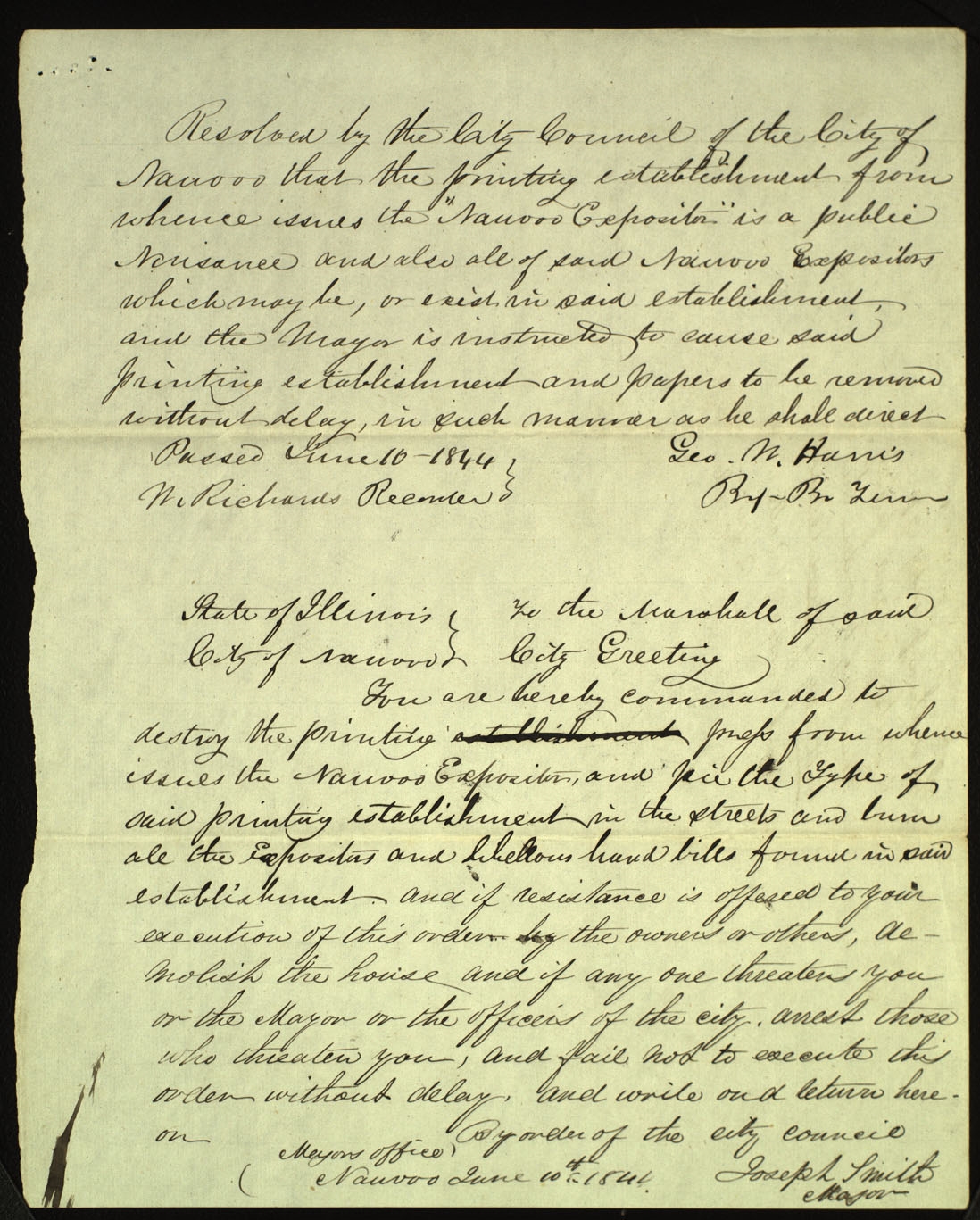
The resolution declared the printing establishment and copies a public nuisance and directed the mayor to remove them. Joseph's order to city marshal John P. Greene directed destruction of the press, scattering of its type, and burning of papers and handbills. It also authorized demolition of the building if resistance was offered.
Council authorization does not remove Joseph's responsibility. He issued the order in his civil office.
Contemporaneous clerk's copy, dated by the Joseph Smith Papers to circa June 25, 1844. The resolution is above the order. Open the image to enlarge it.
The featured document is a copy made by clerks; it is not Joseph's surviving autograph. In a reading that omits the canceled word, the command begins:
“You are hereby commanded to destroy the printing press from whence issues the Nauvoo Expositor”
June 10, about 8 p.m.: The marshal reports the order carried out
The copied return reports that the press and type were destroyed and “pied” according to the order that evening. Pied type was jumbled or scattered movable printing type.
Hemlock Knots’ presentation proposes that currency-related conflicts help explain the destruction. Its account distinguishes Joseph from alleged counterfeiters and notes his opposition to counterfeiting. Represent that position accurately before assessing it.
The June 8 testimony gives this question a contemporary basis. It is stronger evidence of the surrounding conflict than an unrelated later rumor would be. The inference about motive still needs testing:
Question
What to check
What happened?
Separate an accusation from independent evidence of the alleged activity. Identify who is accused.
Who knew what, and when?
Establish what the decision-makers knew before the June 10 order. Date later accounts separately.
What connects the allegation to this press?
Look for a specific threat, exposure, interest, or decision that makes the proposed connection more likely.
How well does the explanation fit?
Compare it with the paper’s religious and political challenges and the council’s stated fear of unrest. Motives may combine.
Motive is often inferred from converging circumstances; a written confession is not required. Conversely, establishing counterfeiting elsewhere in Nauvoo would not alone establish why this press was destroyed. The absence of an admission does not refute the theory, and a list of accusations does not complete the causal argument.
The revised synopsis published June 17 should also be distinguished from the earlier rough record. Both can matter, but a later summary should not silently be presented as the precise words recorded at the moment of a decision.
Explanation, Law, and Moral Judgment
The Church’s public history essay acknowledges Joseph’s order, explains the fear of violence, and summarizes the legal argument with qualifications. It distinguishes arguments about suppressing copies from authority to destroy the press itself. It does not present the council’s resolution as an uncontested judicial vindication.
An official’s belief that an action is legal is evidence about the official’s reasoning. It is not itself a legal judgment. Fear of violence may explain urgency without establishing that this response was justified.
My judgment is that destroying an opposition press was a wrong use of civil power. That is a moral assessment, rather than a claim that this page has adjudicated every question of 1844 law. The publishers’ hostility does not remove the need to examine the government’s response.
A Believing Response
I believe Joseph was called to restore the gospel. That belief does not require treating a mayoral decision as a revelation or defending every exercise of civil authority. The press was destroyed under his order, and a faithful account should acknowledge his responsibility.
Fallibility also cannot become a device that excuses any action without examination. This event is evidence a reader can weigh in assessing Joseph’s leadership. The further conclusion that his prophetic calling was false requires an argument about what the action establishes and how it bears on the wider Restoration claims. See prophetic authority and mistakes for that distinction.
I would answer: “Yes, Joseph ordered the destruction. I regard that decision as wrong. The council’s stated explanation was public nuisance and fear of unrest; counterfeiting accusations were also part of the conflict. We should examine evidence for each proposed motive without pretending that one allegation settles it. I still believe God called Joseph, while holding his civil decisions open to serious criticism.”
This page checks the order, its execution, the recorded counterfeiting accusation, and the inference about motive. It does not audit every accusation, later indictment, or event in Hemlock Knots’ larger account. Quotations from the handwritten documents regularize capitalization and line breaks where indicated.