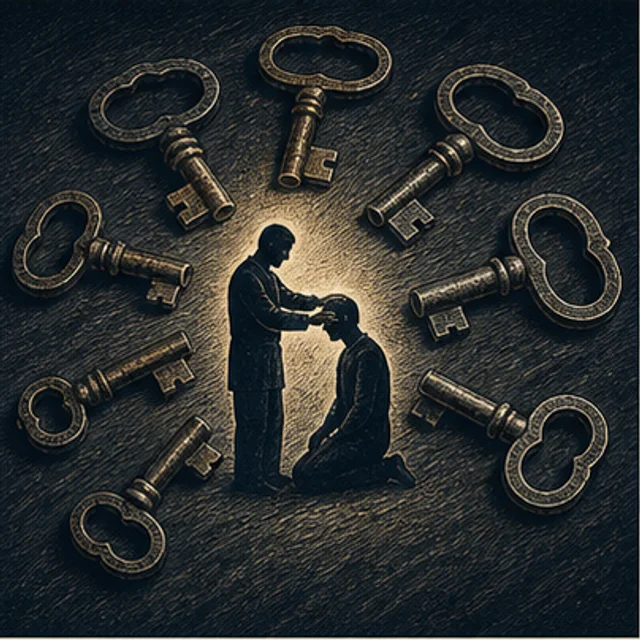
The question
Hebrews describes Jesus as priest forever after the order of Melchizedek. Robert M. Bowman Jr. argues that Melchizedek foreshadows Christ’s unique position and that the biblical phrase supplies no line of ordinations. James White and Mormonism Research Ministry argue that Christ’s permanent priesthood excludes the priesthood claimed by Latter-day Saints. Bowman · White · Mormonism Research Ministry
Hebrews teaches that Jesus remains our high priest and that His sacrifice was sufficient. The question is whether His permanent office also prevents Him from authorizing others to serve under Him.
What Hebrews says about Christ
Psalm 110:4 supplies the promise that Hebrews applies to Jesus. Earlier priests had successors because they died. Jesus lives forever, keeps His office, and continues to intercede for people who come to God through Him. He offered Himself once. Psalm 110:4 · Hebrews 7:23–28
Hebrews 10 makes a second contrast. Earlier priests offered sacrifices repeatedly. Christ offered a single sacrifice for sins and sat down at God’s right hand. Latter-day Saint ordination leaves that saving act to Christ. Hebrews 10:11–14
Does permanent mean nontransferable?
The KJV describes Christ’s priesthood as unchangeable. The NASB says He holds it permanently. Even if we grant the strongest reading, that nobody succeeds Jesus in His office, giving someone an assignment does not require handing over that office. In Matthew 28, the risen Christ affirms that all authority has been given to Him and sends disciples to teach and baptize. Their commission takes place under the authority He retains. Hebrews 7:23–25, NASB · Matthew 28:18–20
Bowman’s point about the word order still stands. Hebrews 7:15 describes another priest arising in Melchizedek’s likeness. That comparison alone cannot establish a chain of ordinations or the names of modern priesthood offices. Hebrews 7:11–17 · Bowman’s discussion of the order
What Latter-day Saints claim
Doctrine and Covenants 107 describes the Melchizedek Priesthood as authority to administer in spiritual things. Alma 13 says priests were ordained after the order of the Son to teach people to look to Him for redemption. Both sources describe authority to serve under Christ, who continues as the source of redemption. Doctrine and Covenants 107:1–8, 18–19 · Alma 13:1–2, 14–19
Matthew’s account shows that Christ’s authority is compatible with authorizing servants. Identifying the authority He gave Joseph Smith and Oliver Cowdery takes separate evidence. Doctrine and Covenants 27 identifies Peter, James, and John in that account. Readers can compare when details about the reported visits appear in the surviving documents. Doctrine and Covenants 27:12–13 · Priesthood restoration accounts