Their Best Arguments (Know These)
- Matthew 16:18: “Gates of hell shall not prevail” = church cannot fail
- Apostolic succession: Irenaeus and Tertullian trace unbroken bishop lists
- 2,000 years of institutional continuity: Catholic/Orthodox churches still exist
- Matthew 28:20: “I am with you always, even unto the end of the world”
- John 16:13: Holy Ghost will “guide you into all truth”
Flip the Protestant Lens Around
Before a Protestant critic treats institutional rupture as impossible, ask why Protestantism exists. The Reformation rejected Rome’s claim to be the binding authority of Christ’s church. Some classic Protestant confessions went much further than saying a few leaders behaved badly. The 1689 London Baptist Confession called the pope “that antichrist, that man of sin, and son of perdition.”
That does not prove the full Latter-day Saint account of apostasy. It does establish a revealing point: historic Protestants already believed a major Christian institution could preserve scripture while becoming seriously corrupt in doctrine and authority. The real dispute is not whether large-scale corruption is possible. It is where the break occurred, what was lost, and whether reform alone could restore authority.
Was “Great Apostasy” a Protestant Idea?
Use the careful version. The word apostasia comes from the New Testament, so Protestants did not invent the word. But the broad story of a church corrupted by Rome has a strong Protestant pedigree. Latter-day Saint scholars note that earlier LDS writers drew heavily from Protestant histories of Christian decline.
The Roger Williams Pressure Point
Roger Williams did not found the Baptist movement worldwide. He helped establish the first Baptist church in North America, then left it within months. The Library of Congress records that he remained unaffiliated and was later described as a Seeker. Scholarship on the Seekers also documents his doubts about baptism and the need for renewed apostolic authority.
The fair conclusion is not “Williams would certainly have joined Joseph Smith.” We cannot know that. The useful conclusion is narrower: a major early American Baptist figure saw the same authority problem that Restorationists later pressed. Scripture and sincerity alone did not tell him who was authorized to rebuild the New Testament church.
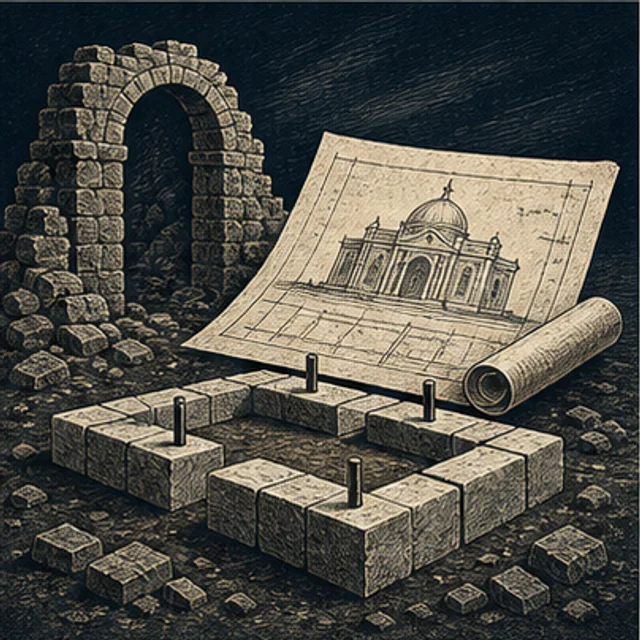
Object Lesson: The Damaged Blueprint
Devin Barnes of Latter-day Logic asks listeners to picture an architect who gives a construction crew the plans for a building. The plans are damaged, so the crew fills in the gaps and builds what it can. The architect later returns with an intact copy. The first crew rejects it because the restored building does not resemble the structure they built from fragments.
Ask:
“Should the damaged building judge the intact plans, or should the plans judge the building?”
The lesson explains why a restoration would look wrong to people who inherited a later version of Christianity. It does not prove the apostasy. Establish that from scripture, authority, and history.
Open the full object lesson and live response
Core Response: The Bible Itself Prophesies Apostasy
Christ Warned It Would Happen
- Matthew 24:4-5, 11-12: Many false prophets, many deceived, love waxing cold
- Matthew 24:24: False Christs so convincing they could “deceive the very elect”
- Luke 18:8: “When the Son of man cometh, shall he find faith on the earth?” (Implied answer: no)
Paul Explicitly Prophesied It
- 2 Thessalonians 2:1-4: Second Coming cannot happen “except there come a falling away [apostasia] first”: the literal Greek word for apostasy
- Acts 20:29-30: “Grievous wolves… of your own selves shall men arise, speaking perverse things”
- 1 Timothy 4:1-3: “Depart from the faith, giving heed to seducing spirits and doctrines of devils”
- 2 Timothy 4:3-4: “Turn away their ears from the truth, turned unto fables”
- 2 Timothy 1:15: “All they which are in Asia be turned away from me”: apostasy already happening
Other Apostles Confirmed It
- 2 Peter 2:1-2: False teachers, “many shall follow their pernicious ways”
- 1 John 2:18-19: “Even now are there many antichrists”
- Jude 1:3-4: “Certain men crept in unawares”
- Revelation 2-3: 5 of 7 churches rebuked by Christ himself
Old Testament Foreshadowing
- Amos 8:11-12: “A famine of hearing the words of the Lord”
- Isaiah 24:5: “Changed the ordinance, broken the everlasting covenant”
- Isaiah 60:2: “Darkness shall cover the earth”
Scriptures Prophesying the Restoration
- Acts 3:19-21: “Times of restitution of all things”: why restitute if nothing was lost?
- Daniel 2:44: God shall “set up a kingdom” in the last days
- Revelation 14:6: Angel bringing “the everlasting gospel”: unnecessary if the gospel was never lost
- Isaiah 29:13-14: “A marvellous work and a wonder”
- Malachi 4:5-6: Elijah to come before the great day
One-Line Responses to Objections
| Objection | Response |
|---|
| ”Gates of hell shall not prevail” (Matt 16:18) | Hades is the realm of the dead. Its gates hold the dead in; they are not a picture of an institution being protected from administrative or doctrinal change. Christ’s Resurrection breaks the power of death. The NET Bible notes that the phrase can be translated “the power of death.” |
| Apostolic succession proves continuity | Aaronic priesthood was passed down in unbroken succession too, and Israel still fell into apostasy repeatedly. Institutional lineage is not the same as divine authority. |
| Good Christians always existed | We agree. The apostasy was a loss of priesthood authority and fullness of the gospel, not the disappearance of all good people. |
| The Reformation was self-correction | Reform only follows once someone judges the inherited church to be seriously wrong. The remaining question is whether reformers could restore apostolic authority by correcting doctrine alone. Roger Williams’s doubts show that this was a real Protestant problem, not a later LDS invention. |
| How was the Bible preserved if there was apostasy? | Preserving scripture and preserving every office, ordinance, and authority are different claims. The persistence of major interpretive disputes shows why a text still needs an account of authority. |
| ”I am with you always” (Matt 28:20) | Christ can be with individuals and sustain the faithful without the institutional church retaining full authority. He was “with” Israel during the exile too. |
| No evidence for total apostasy | We don’t claim total: we claim loss of authority and fullness. Plenty survived. But the Nicene Creed used Greek philosophical terms (homoousios) not found in scripture. Baptism for the dead (1 Cor 15:29) disappeared. That’s evidence of change. |
Historical Evidence (Quick Hits)
- Spiritual gifts ceased: Chrysostom (c. 390 AD) admitted the gifts Paul described “now no longer take place”
- Greek philosophy absorbed: Justin Martyr, Clement, Origen all merged Christianity with Platonism
- Governance changed: NT uses bishop/elder interchangeably (Acts 20:17, 28; Titus 1:5-7); by Ignatius (c. 110 AD), monarchical bishops emerge
- Ordinances lost: Baptism for dead condemned; laying on of hands changed; pre-mortal existence taught by Origen, later condemned (553 AD)
- Tertullian left: The very Church Father cited for apostolic succession eventually abandoned the mainstream church for the Montanists
The Biblical Pattern
Apostasy and restoration is God’s consistent pattern:
- Pre-Flood apostasy → Restoration through Noah
- Post-Babel → Restoration through Abraham
- Israel in Egypt (400 years) → Restoration through Moses
- Judges (repeated cycles) → Restoration through prophets/kings
- Divided kingdom → Exile → Return under Ezra/Nehemiah
- Intertestamental period (~400 years of prophetic silence)
- Post-apostolic apostasy → Restoration through Joseph Smith
The critic must explain why the Christian dispensation would be the one exception to this pattern.
Key Quotes for Debate
“This whole place is very obscure: but the obscurity is produced by our ignorance of the facts referred to and by their cessation, being such as then used to occur but now no longer take place.”: John Chrysostom, on spiritual gifts (Homilies on 1 Corinthians, 29.2)
“The conspiracy of godless error took its rise through the treachery of false teachers, who… now tried without shame to preach ‘knowledge falsely so called’ against God.”: Eusebius, Church History 3.32.7-8, describing the post-apostolic period
Resources
Introduction
One of the most fundamental claims of the Restoration is that a great and universal apostasy occurred following the death of the original apostles, necessitating a restoration of Christ’s church, priesthood authority, and fullness of the gospel. Critics challenge this claim by asserting that the church Christ established has persisted in an unbroken line from the apostles to the present day, primarily through the Catholic and Orthodox traditions. This document examines the biblical, historical, and doctrinal evidence for a widespread apostasy and responds to the strongest objections against it.
The Criticism (Steelmanned)
The critic’s case rests on several powerful pillars:
-
Christ’s own promise: In Matthew 16:18, Jesus declared, “Upon this rock I will build my church; and the gates of hell shall not prevail against it.” If a total apostasy occurred, then hell did prevail, and Christ’s promise failed. This is perhaps the single strongest objection.
-
Apostolic succession: Church Fathers such as Irenaeus (Against Heresies 3.3.1-3) and Tertullian (Prescription Against Heretics 32) trace unbroken lines of bishops from the apostles through their own day. These are not vague claims but named, sequential lists of bishops in specific cities.
-
Institutional continuity: The Catholic and Orthodox churches have maintained continuous institutional existence, liturgical practice, and creedal belief for nearly two millennia. The sheer weight of this historical continuity demands explanation.
-
Christ’s other promises: Jesus said he would be with his disciples “always, even unto the end of the world” (Matthew 28:20) and that the Holy Ghost would “guide you into all truth” (John 16:13). These seem to preclude a total loss of truth.
-
The “gates of hell” metaphor: In ancient Near Eastern context, “gates” are defensive structures. Christ’s church is the aggressor; hell is on defense. The church is promised ultimate victory, not defeat through apostasy.
This is a genuinely strong case that deserves careful, honest engagement rather than dismissal.
The Protestant Inheritance in the Apostasy Debate
The Restoration did not invent the idea that the visible church could depart badly from apostolic Christianity. The word apostasia is biblical, and Protestant reformers had already built a sweeping case that Rome had corrupted Christian teaching and authority. The 1689 London Baptist Confession did not describe the papacy as a mostly healthy institution in need of a tune-up. It identified the pope with the “antichrist” and “man of sin.”
This does not prove the Latter-day Saint position. Protestantism usually argues that the gospel remained recoverable from scripture and that reform restored faithful teaching without a new conferral of priesthood keys. Latter-day Saints argue that reform could correct ideas but could not recreate an apostolic commission. Still, a Protestant critic cannot dismiss the possibility of deep institutional corruption without explaining the Reformation itself.
It is also too broad to say that Protestants invented the phrase “Great Apostasy.” The Greek word comes from scripture and has never belonged to one tradition. The more defensible historical point is that the familiar fallen-church narrative has a strong Protestant ancestry. The Maxwell Institute’s introduction to Early Christians in Disarray notes that earlier Latter-day Saint writers relied heavily on Protestant scholarship when describing Christian decline.
Roger Williams and the Missing Authority
Roger Williams is a useful example, but only when stated accurately. He did not found the Baptist movement worldwide. He helped establish the first Baptist church in North America, left it within months, and remained unaffiliated. The Library of Congress notes that he was later described as a Seeker. Research on seventeenth-century Seekers also documents his doubts about baptism and the authority by which it was administered.
We cannot honestly claim that Williams would certainly have followed Joseph Smith. History does not let us interview him after 1830. What we can say is that he reached a strikingly Restoration-shaped problem: the New Testament describes apostolic authority, but sincerity and access to scripture do not by themselves confer it. If that authority was absent, who could simply declare it restored?
Object Lesson: The Architect and the Damaged Plans
In his “Mormons Aren’t Christian” illustration and his debate opening on Christian identity, Devin Barnes of Latter-day Logic compares the Restoration to an architect returning to a compromised building project.
The architect supplied the original plans. The crew lost or damaged portions, filled the gaps with its own judgments, and built a structure. When the architect returned with an intact copy, the crew rejected it because it did not match the building they already knew.
The question is:
“Should the later building judge the original plans, or should the original plans judge the building?”
The analogy identifies a circular argument: “The Restoration cannot be Christ’s church because it does not resemble the Christianity we inherited.” If inherited Christianity is the very thing being tested, it cannot be assumed as the untouched standard.
The blueprint does not prove that priesthood authority was lost, that the creeds are wrong, or that Joseph Smith was called. It shows why unfamiliarity is not a refutation. Those larger claims still require scriptural and historical evidence.
Open the object lesson with its live response and guardrail
Biblical Response
The Bible Explicitly Prophesies Apostasy
The New Testament authors themselves: including Christ: repeatedly and explicitly warned of a coming apostasy. These are not vague warnings but specific prophecies of widespread departure from the faith:
Christ’s own warnings:
- Matthew 24:4-5, 11-12: “Many shall come in my name… and shall deceive many. And many false prophets shall rise, and shall deceive many. And because iniquity shall abound, the love of many shall wax cold.”
- Matthew 24:24: “For there shall arise false Christs, and false prophets, and shall shew great signs and wonders; insomuch that, if it were possible, they shall deceive the very elect.”
- Luke 18:8: “When the Son of man cometh, shall he find faith on the earth?” This rhetorical question implies the answer is no, or at best, very little.
Paul’s explicit prophecies:
- Acts 20:29-30: Speaking to the Ephesian elders: “After my departing shall grievous wolves enter in among you, not sparing the flock. Also of your own selves shall men arise, speaking perverse things, to draw away disciples after them.”
- 2 Thessalonians 2:1-4: Paul directly states the Second Coming will not happen “except there come a falling away first” (Greek: apostasia). This is the very word from which “apostasy” derives. Paul treats this as a necessary precondition for Christ’s return.
- 1 Timothy 4:1-3: “The Spirit speaketh expressly, that in the latter times some shall depart from the faith, giving heed to seducing spirits, and doctrines of devils.”
- 2 Timothy 4:3-4: “The time will come when they will not endure sound doctrine… and they shall turn away their ears from the truth, and shall be turned unto fables.”
- 2 Timothy 1:15: “All they which are in Asia be turned away from me.” Paul reports apostasy already occurring in his own lifetime, across an entire region.
Other apostolic warnings:
- 2 Peter 2:1-2: “There shall be false teachers among you, who privily shall bring in damnable heresies… and many shall follow their pernicious ways.”
- 1 John 2:18-19: “Even now are there many antichrists… They went out from us, but they were not of us.”
- Jude 1:3-4: Jude urges the saints to “earnestly contend for the faith which was once delivered unto the saints. For there are certain men crept in unawares.”
- Revelation 2-3: Christ himself, speaking to the seven churches, identifies serious doctrinal and moral corruption already present in the first-century church. Five of seven churches receive stern rebuke.
The critical point: If the Bible itself prophesies apostasy, then the apostasy does not represent a failure of God’s promises: it represents their fulfillment. The critic must explain why these extensive warnings were unnecessary if apostasy could never actually occur.
Reinterpreting Matthew 16:18
The phrase translated “gates of hell” is more literally “gates of Hades.” Hades is the realm of the dead. In biblical imagery, its gates imprison the dead, and only God’s power can open them. The NET Bible’s textual note therefore gives “the power of death” as a possible translation.
Read that way, the promise is about resurrection: death will not hold Christ or finally hold the people He gathers. Revelation uses the same image when the risen Christ declares that He possesses “the keys of hell and of death” (Revelation 1:18). The verse does not say that every apostolic office, ordinance, or institutional structure will continue without interruption.
That reading also fits the wider biblical pattern:
- Christ’s victory is final, not fragile: The Resurrection guarantees that death cannot defeat His work.
- Covenant people can still lose institutions: Israel remained central to God’s purposes through apostasy, exile, a destroyed temple, and later restoration.
- Restoration is not Christ losing: Restoring what people lost is itself an act of divine victory.
Matthew 16:18 is therefore a poor shortcut to guaranteed institutional continuity. A Catholic or Orthodox Christian may make that continuity argument from other historical and theological premises, but “the gates of Hades” does not do all of that work by itself.
The Pattern of Apostasy and Restoration in Scripture
The Great Apostasy is not an anomaly in God’s dealings with humanity: it follows a well-established biblical pattern:
- The pre-Flood world: Near-total apostasy (Genesis 6:5-7), followed by restoration through Noah.
- Post-Babel: Loss of truth, followed by restoration through Abraham.
- Israel in Egypt: Loss of covenant knowledge over 400 years, followed by restoration through Moses.
- The period of the Judges: Repeated cycles of apostasy and restoration (Judges 2:10-19).
- The divided kingdom: Widespread idolatry in both Israel and Judah, despite God’s covenant promises.
- The Babylonian exile: Destruction of the temple, loss of the ark, cessation of many ordinances. The very institution God established was dismantled.
- The intertestamental period: Roughly 400 years with no prophetic voice (acknowledged by Jews and Christians alike as a period of prophetic silence).
If God’s covenant with Israel did not prevent repeated apostasies, destructions, and exiles, there is no reason to assume His covenant with the Christian church would function differently.
Early Christian Evidence
Evidence of Rapid Doctrinal Change
The historical record shows dramatic and rapid changes in Christian doctrine and practice within the first few centuries:
Loss of spiritual gifts: By the mid-second century, writers like Justin Martyr acknowledged that miraculous gifts were becoming rare. By the time of Chrysostom (late 4th century), he wrote that the spiritual gifts described by Paul had ceased entirely: “This whole place is very obscure: but the obscurity is produced by our ignorance of the facts referred to and by their cessation, being such as then used to occur but now no longer take place” (Homilies on 1 Corinthians 29.2).
Adoption of Greek philosophy: The earliest Christian writers engaged with and eventually absorbed significant elements of Greek philosophical thought:
- Justin Martyr (c. 100-165 AD) explicitly described Christianity as a philosophy and used Platonic categories to explain Christian theology.
- Clement of Alexandria (c. 150-215 AD) argued that Greek philosophy was a “schoolmaster” to bring Greeks to Christ, similar to the Law of Moses for Jews.
- Origen (c. 185-254 AD) developed an elaborate theological system deeply influenced by Neoplatonism.
- The Nicene Creed (325 AD) employed the Greek philosophical term homoousios (“of one substance”): a word found nowhere in scripture: to define the nature of God.
Changes in church governance: The New Testament describes a church led by apostles and prophets (Ephesians 4:11-14), with the offices of bishop (episkopos) and elder (presbyteros) used interchangeably (Acts 20:17, 28; Titus 1:5-7). By the early second century, Ignatius of Antioch was already advocating for a monarchical episcopate (single bishop over each city): a structure not found in the New Testament. The development of the papacy, metropolitans, and patriarchs represents further institutional evolution.
Loss of ordinances and teachings: Several practices described in the New Testament disappear or change dramatically:
- Baptism for the dead (1 Corinthians 15:29): practiced in the early church but later condemned.
- The laying on of hands for the gift of the Holy Ghost as a separate ordinance from baptism (Acts 8:14-17; 19:5-6).
- The concept of a pre-mortal existence, which Origen taught but was later condemned at the Second Council of Constantinople (553 AD).
- The corporeal nature of God, which several early Fathers affirmed but which was later replaced by an incorporeal, philosophically-derived view.
What the Church Fathers Actually Show
Ironically, the Church Fathers whom critics cite as evidence of continuity actually provide significant evidence of discontinuity:
- Irenaeus (Against Heresies, c. 180 AD) wrote precisely because heresy was rampant. His work documents the extraordinary proliferation of false teachings within the first 150 years of Christianity.
- Tertullian himself eventually left the mainstream church to join the Montanists, dissatisfied with what he saw as the church’s spiritual decline.
- Cyprian of Carthage (c. 250 AD) documented widespread moral corruption among clergy and laity alike.
- Eusebius (Church History, c. 325 AD) records that by the end of the apostolic age, the “sacred chorus of the apostles” had passed and “the conspiracy of godless error took its rise through the treachery of false teachers” (3.32.7-8).
The Fathers’ own writings reveal a church in constant struggle against internal corruption and doctrinal deviation: precisely the condition one would expect during an ongoing apostasy.
LDS Doctrinal Position
The Latter-day Saint understanding of the Great Apostasy includes several key elements:
-
Loss of priesthood authority: The apostasy was not merely a corruption of doctrine but a loss of the priesthood authority necessary to perform saving ordinances and lead Christ’s church. When the last apostle died, the keys of the priesthood were no longer on earth.
-
Gradual process: The apostasy did not happen overnight. It was a process that began during the apostles’ lifetimes (as Paul and others documented) and continued over centuries. Many sincere, faithful Christians preserved important truths even as the fullness of the gospel was lost.
-
Not total destruction of all truth: The LDS position does not claim that all truth was lost. The Bible was preserved (though with some textual corruption). Many correct principles about Christ, morality, and devotion survived. The creeds of Christendom contain much that is true. What was lost was the fullness of the gospel: the complete priesthood authority, the complete ordinances, and the complete doctrinal framework.
-
Fulfillment of prophecy: The apostasy was foreseen and prophesied. It was not a failure of God’s plan but part of it. Just as the scattering of Israel was prophesied (Deuteronomy 28), so was the gathering. Just as the apostasy was prophesied, so was the restoration (Acts 3:19-21: “the times of restitution of all things, which God hath spoken by the mouth of all his holy prophets since the world began”).
-
The Restoration as the answer: The restoration through Joseph Smith was the prophesied response to the prophesied apostasy. Daniel 2:44-45 speaks of God setting up a kingdom “in the last days” that would “never be destroyed”: language suggesting previous kingdoms were disrupted. Revelation 14:6 describes an angel bringing “the everlasting gospel” to earth: an event unnecessary if the gospel had never been lost.
Key Scriptures
Prophesying the Apostasy
| Scripture | Key Text |
|---|
| 2 Thessalonians 2:1-4 | ”A falling away [apostasia] first” before Christ’s return |
| Acts 20:29-30 | ”Grievous wolves… of your own selves shall men arise” |
| 1 Timothy 4:1-3 | ”Depart from the faith, giving heed to seducing spirits” |
| 2 Timothy 4:3-4 | ”Shall turn away their ears from the truth” |
| 2 Timothy 1:15 | ”All they which are in Asia be turned away from me” |
| Matthew 24:4-5, 11-12, 24 | Many false prophets, false Christs, love growing cold |
| Luke 18:8 | ”Shall he find faith on the earth?“ |
| 2 Peter 2:1-2 | ”False teachers… many shall follow” |
| Amos 8:11-12 | ”A famine… of hearing the words of the Lord” |
| Isaiah 24:5 | ”Changed the ordinance, broken the everlasting covenant” |
| Isaiah 60:2 | ”Darkness shall cover the earth, and gross darkness the people” |
Prophesying the Restoration
| Scripture | Key Text |
|---|
| Acts 3:19-21 | ”Times of restitution of all things” |
| Daniel 2:44-45 | God shall “set up a kingdom” in the last days |
| Revelation 14:6 | An angel bringing “the everlasting gospel” |
| Isaiah 29:13-14 | A “marvellous work and a wonder” |
| Ephesians 1:10 | ”Gather together in one all things in Christ” |
| Malachi 4:5-6 | Elijah to come before the “great and dreadful day” |
Responses to Common Objections
”Matthew 16:18: The gates of hell shall not prevail”
Response: The “gates of hell” (Greek: pylai hadou) most naturally refers to the power of death. Christ is promising that death will not hold Him or finally hold His people. The Resurrection fulfills that promise. Nothing in the phrase says that every apostolic office, ordinance, or institutional structure must continue without interruption. A Catholic or Orthodox Christian may argue for continuity from other premises, but Matthew 16:18 does not establish the point by itself.
”Apostolic succession proves continuity”
Response: Apostolic succession, as claimed by Catholic and Orthodox traditions, proves institutional lineage but not doctrinal or spiritual continuity. A chain of ordinations means little if what is being passed down has changed. The Aaronic priesthood was passed down in unbroken succession through much of Israel’s history, yet this did not prevent Israel from falling into apostasy repeatedly. Moreover, LDS theology holds that the authority to act in God’s name requires more than institutional lineage: it requires divine authorization. When the apostles died without passing on all the keys they held, the authority was lost regardless of how many bishops were subsequently ordained.
”Good Christians have always existed: there was no total apostasy”
Response: The LDS position does not require that all good Christians disappeared or that all truth was lost. It requires that priesthood authority and the fullness of the gospel were lost. Many faithful, sincere Christians preserved important truths throughout the centuries. God worked through reformers like Luther, Calvin, Tyndale, and others to prepare the way for the Restoration. The existence of faithful Christians does not disprove the loss of institutional authority any more than the existence of faithful Israelites during the Babylonian exile disproved the destruction of the temple and the loss of its ordinances.
Response: The Reformation establishes that serious institutional corruption is compatible with preserving scripture and sincere believers. That is already a large concession. The remaining disagreement concerns the remedy. Protestants hold that the church could be reformed by returning to scripture. Latter-day Saints hold that correcting doctrine cannot, by itself, confer priesthood keys or recreate apostolic offices. Roger Williams’s short stay with the first Baptist church in North America and his later Seeker position show that the authority question was not invented by Latter-day Saints.
”If there was an apostasy, how was the Bible preserved?”
Response: The preservation of the Bible is actually consistent with the apostasy. God preserved the scriptural record precisely because living prophetic authority would be temporarily lost. The Bible served as a witness and a preparation for the Restoration. However, the Bible itself acknowledges that not all of God’s word was preserved in it (John 21:25; 1 Corinthians 5:9; Colossians 4:16: references to lost epistles). Moreover, the Bible alone, without prophetic authority to interpret it, has produced thousands of competing denominations: evidence that the text alone is insufficient without the authority and revelation that originally accompanied it.
Conclusion
The New Testament contains serious warnings about falling away, false teachers, and changes to apostolic teaching. History also records major developments in doctrine, worship, and church government after the apostles. Those facts do not prove every detail of the Latter-day Saint apostasy narrative, but they make the claim a biblical and historical argument rather than an excuse invented after the fact. Latter-day Saints understand the Restoration as God’s answer to that loss and as the means by which Christ’s work finally prevails.
Resources