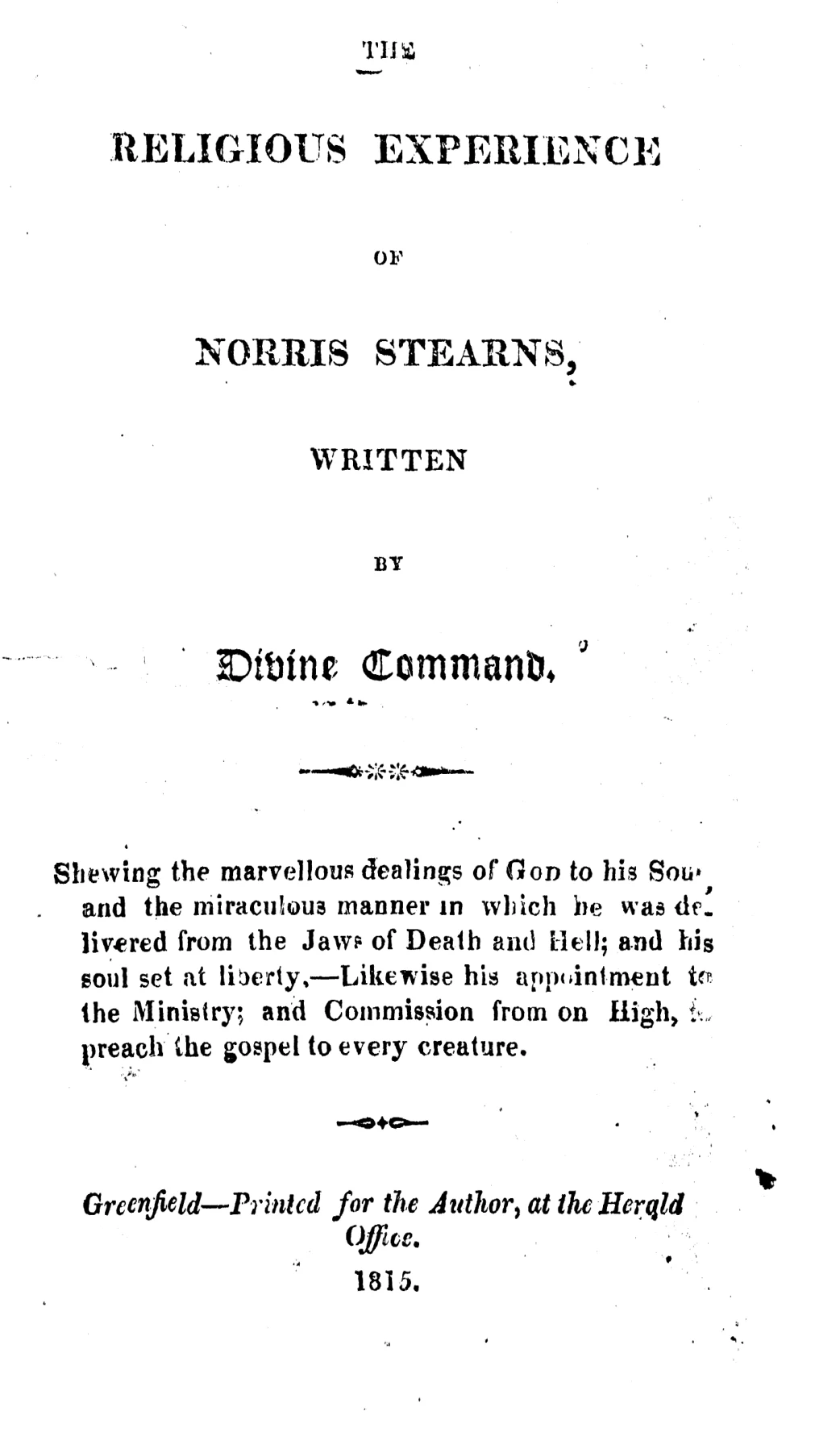
Yes, Norris Stearns and Elias Smith published accounts resembling parts of Joseph’s First Vision before 1820. Stearns describes God and Jesus; Elias describes heavenly light after a timber accident in the woods. These are genuine parallels. They make influence worth examining, but do not by themselves establish borrowing or fabrication. Compare the full passages, distinctive wording, dates, and plausible routes of influence.
Questions that test the framework
Which publication and which Joseph Smith account are being compared, and what existed by each date?
What evidence favors dependence on this particular narrative over shared biblical language or religious vocabulary?
If influence on the wording is likely, what further evidence would establish that the underlying experience was invented?
The Short Answer
Yes, earlier published accounts resemble parts of Joseph Smith’s First Vision. That establishes precedents and raises a fair influence question. It does not by itself establish that he copied a particular account or fabricated the experience.
Two Examples to Know
Norris Stearns, published 1815: Describes heavenly light, God, and Jesus. The experience is set in a room and bed. Do not claim that Joseph was the first person to describe seeing God and Jesus distinctly.
Elias Smith, published 1816: Describes light in the woods. He had gone to collect timber and fallen partly beneath a log. His description of the Lamb explicitly quotes Revelation 14:1. It is not an account of retiring to pray about which church to join.
The publication dates precede Joseph’s reported 1820 event. Joseph’s earliest surviving firsthand account dates to about summer 1832. Those are different kinds of dates.
Test the Inference
Read the full passages, including the setting and purpose.
Ask how the proposed source could have reached Joseph. Ownership documentation is helpful, but its absence does not exclude influence.
Compare distinctive wording and sequences with shared biblical language.
Separate possible influence on a telling from the claim that the event was invented. Differences do not automatically rule out adaptation either.
Say This
“The parallels are real. Let’s check whether the wording and history support borrowing from this particular account, and then ask what that would tell us about the experience itself. I believe Joseph’s witness without needing every feature of his narrative to be unprecedented.”
Other people published accounts of heavenly light and divine encounters before Joseph Smith’s reported 1820 vision. Norris Stearns even described God and Jesus distinctly. A defense that depends on there being no earlier parallels fails.
The further claim that Joseph copied these accounts needs more than the existence of similar stories. We need to compare the wording, chronology, surrounding narrative, and plausible routes of influence. The two publications examined here establish genuine precedents. They do not, by themselves, establish Joseph’s dependence on either author or settle whether he experienced a divine encounter.
Latter-day Saints can believe Joseph’s witness without claiming that God had never appeared to anyone else or that Joseph used unprecedented language to describe what happened.
The Criticism at Its Strongest
Mormon Handbook’s plagiarism argument puts earlier accounts beside Joseph’s: distress, light, a divine encounter, and difficulty describing divine glory. The argument is that Joseph could have drawn on available religious narratives when composing his own account. The gap between the reported 1820 event and his earliest surviving written account in 1832 gives that possibility historical room.
This is stronger than merely pointing out that other people claimed visions. It proposes a source for features of Joseph’s narrative. It deserves an actual comparison, including the passages that the comparison table leaves out.
Keep Three Dates Separate
Account
Publication or surviving record
What that date establishes
Norris Stearns
Pamphlet published in 1815
This printed account existed before Joseph’s reported 1820 experience. The publication year is not the date of Stearns’s experience.
Elias Smith
Autobiography, volume 1, published in 1816
This account also existed in print before 1820. The passage on pages 58–59 gives no exact date for the experience.
Joseph Smith
Reported event in 1820; earliest surviving firsthand account circa summer 1832
The 1832 manuscript is evidence of what Joseph recorded then. It is not a surviving diary entry from 1820.
Joseph’s familiar account
History project begun in 1838; surviving manuscript history written from 1839 onward
Comparisons with its wording concern a later telling. Do not treat every phrase in that account as documented in 1820 or the surviving manuscript as an 1838 diary.
The familiar label “1838 account” refers to the history project begun that year. The Joseph Smith Papers history introduction dates the work on the surviving manuscript history to June 1839 onward.
An earlier publication makes influence chronologically possible. It does not establish how widely that edition circulated or whether Joseph encountered it. Conversely, the lack of a surviving record that Joseph owned the book does not exclude reading, hearing, or indirect influence.
Influence on an 1832 or later telling could have occurred after 1820. Date the proposed contact against the account whose wording is being explained, rather than automatically requiring contact before the reported event.
Norris Stearns: A Substantial Parallel
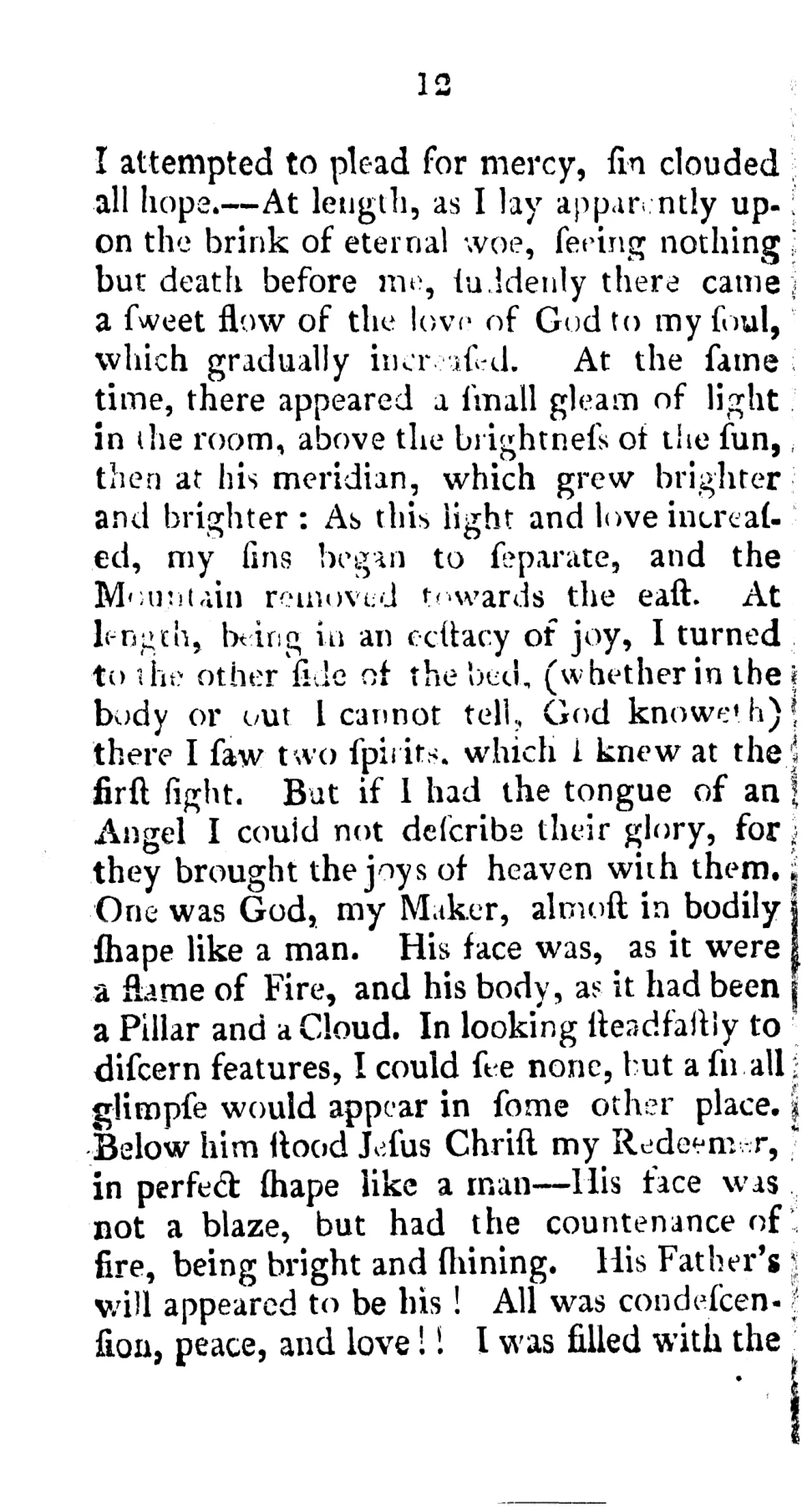
The title page of The Religious Experience of Norris Stearns, Written by Divine Command gives the publication date as 1815. On printed page 12, Stearns describes distress followed by light in his room, “above the brightness of the sun.” Turning to the other side of the bed, he reports “two spirits.” He identifies one as God, “almost in bodily shape like a man,” and Jesus below him, “in perfect shape like a man.”
Those are real similarities. It would be inaccurate to say that no pre-1820 printed account distinguished God and Jesus in a vision.
The surrounding details matter too. Stearns describes a room and a bed. God’s appearance includes flame, a pillar, and a cloud; Stearns says he cannot discern features. Joseph’s familiar account describes deliberate prayer in the woods and two personages standing above him, with one introducing the other. These differences identify what each narrative actually says. They do not rule out the possibility that an author could adapt another account.
Read Stearns's original page 12Norris Stearns, 1815, printed page 12. Open the image to enlarge it. Scan from the public-domain pamphlet preserved by Internet Archive and mirrored on Wikimedia Commons.
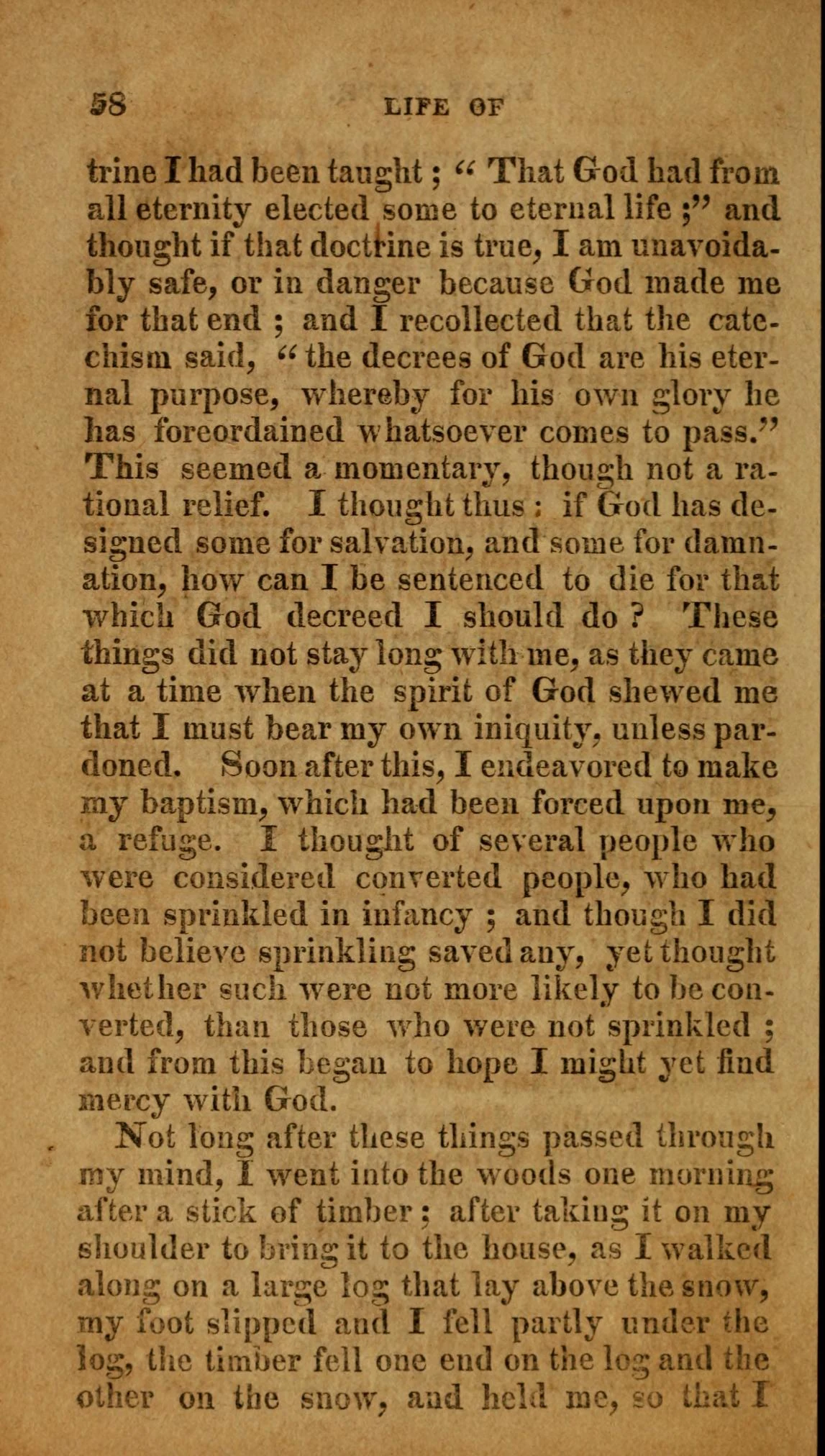
Elias Smith’s The Life, Conversion, Preaching, Travels, and Sufferings of Elias Smith, volume 1 (1816), describes going into the woods one morning. Read that phrase alone and it sounds very close to Joseph’s retreat for prayer.
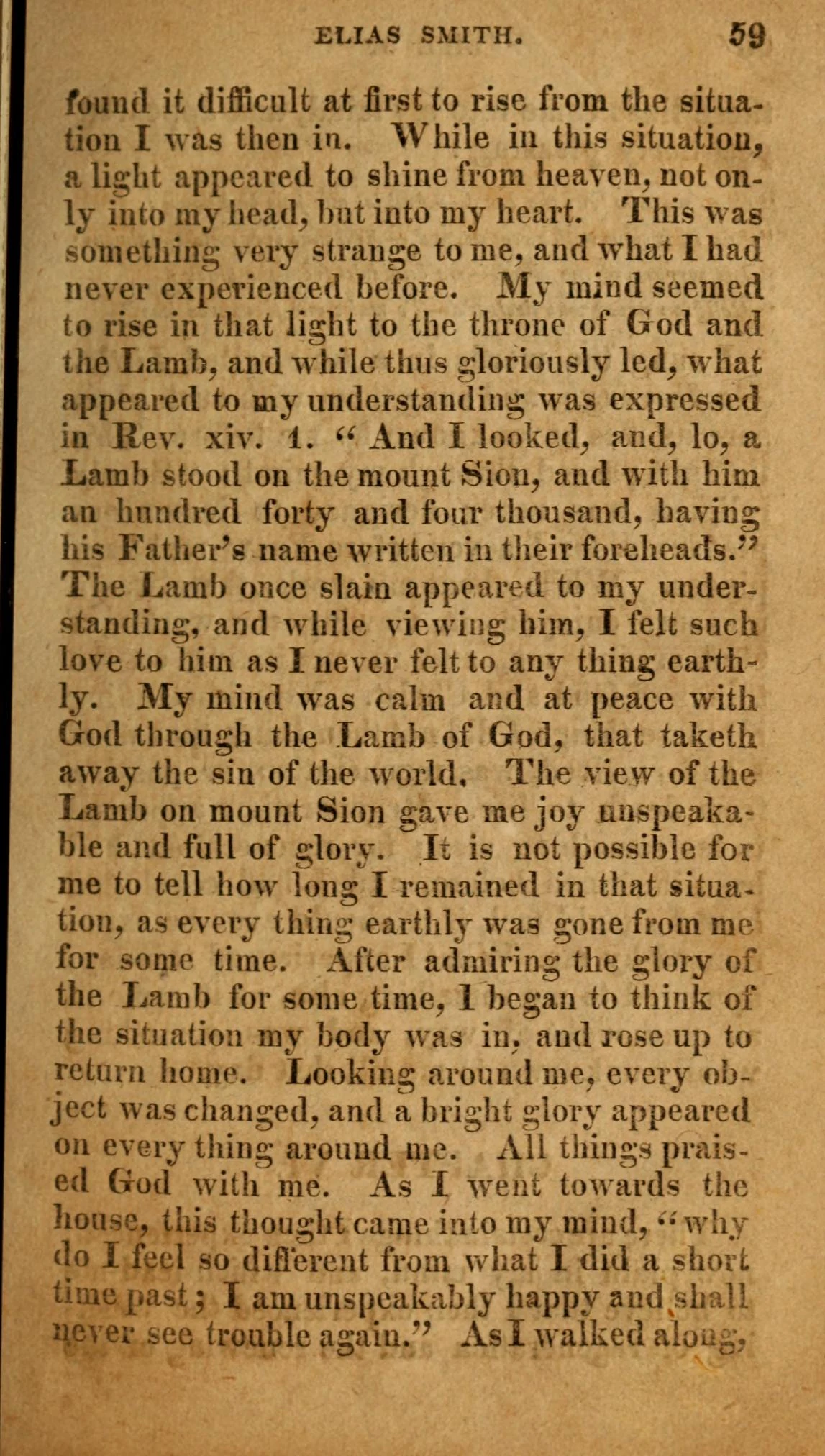
Printed page 58 supplies the purpose: Elias went “after a stick of timber.” He slipped while crossing a log above the snow and fell partly beneath it. The timber held him so that he initially struggled to rise. Page 59 then describes light from heaven entering his head and heart, his mind seeming to rise to the throne of God and the Lamb, and the Lamb appearing “to my understanding.”
Elias explicitly quotes Revelation 14:1. His description is framed through a biblical scene. It is evidence for a divine encounter described in familiar Christian imagery, rather than a second account of Joseph’s exact question and answer about which church to join.
The woods and heavenly light remain genuine points of comparison. Restoring the timber and log-fall context gives us a more accurate comparison; it does not make influence impossible.
Read Elias Smith's original pages 58–59Printed page 58 gives the reason for entering the woods and the accident.Printed page 59 describes the light and the Lamb. Public-domain scans from Internet Archive's copy of the 1816 volume.
Which edition existed before the account being compared?
A date attached to the reported experience is not automatically a publication date.
How might the material have reached Joseph?
Local circulation, an intermediary, or evidence of reading can strengthen an influence hypothesis. A personal ownership receipt is not required.
How distinctive is the shared wording?
A rare sequence of wording and details carries more weight than broad themes such as light, fear, forgiveness, and joy.
What alternative sources explain the language?
Shared scripture and religious vocabulary can produce resemblance without direct dependence on this particular book.
Does the explanation account for the whole comparison?
Include differences and surrounding passages. Do not select only matching phrases or assume differences make adaptation impossible.
What conclusion follows if influence is likely?
Influence on wording, influence on a later retelling, and fabrication of an event are different conclusions. Each needs support.
These are historical judgments, not a demand for impossible proof. Several converging clues can support literary dependence even without a surviving confession. The point is to weigh those clues against alternatives instead of treating a side-by-side table as a completed explanation.
The Latter-day Saint Response
The Restoration’s claim is that God answered Joseph and called him to a work. That claim does not require every feature of his account to be unlike every earlier Christian account. Similar reports can tell us about the religious language available to him without deciding whether his testimony is true.
A critic may argue that the parallels, delayed recording, and differences among Joseph’s accounts jointly favor invention. A believing response should address that cumulative argument rather than pretending each question stands alone. It should also weigh Joseph’s testimony and the broader case for the Restoration, including the Book of Mormon witnesses, instead of making narrative novelty the test of revelation.
My conclusion is limited but firm: these two publications defeat the claim that Joseph’s narrative had no precedents. They do not establish the stronger accusation that he copied his experience into existence. I believe his witness; that belief does not need the earlier accounts to disappear.
A Reply You Can Use
“Yes, there are earlier parallels. Stearns describes God and Jesus, and Elias Smith describes heavenly light in the woods. Let’s read the complete passages and compare the dates and wording. Those similarities make influence a fair question. What evidence favors dependence on these particular accounts over shared religious language, and what would connect that dependence to fabrication? My belief in Joseph doesn’t depend on his being the first person to describe a vision.”
Sources and Scope
Norris Stearns, The Religious Experience of Norris Stearns, Written by Divine Command (Greenfield, 1815), title page and printed page 12. Complete facsimile.
Elias Smith, The Life, Conversion, Preaching, Travels, and Sufferings of Elias Smith, vol. 1 (Portsmouth, 1816), printed pages 58–59. Complete volume.
Joseph Smith Papers, Accounts of the First Vision, with links to the surviving firsthand and contemporary accounts.
Mormon Handbook, First Vision: Plagiarized. This is the critical argument being examined, not an independent verification of its borrowing conclusion.
This page checks the Stearns and Elias Smith passages, not every account in either modern collection. Publication, recording, and reported event dates must be checked separately for any additional example. Short quotations above regularize line breaks and the long printed s; the scans preserve the originals.