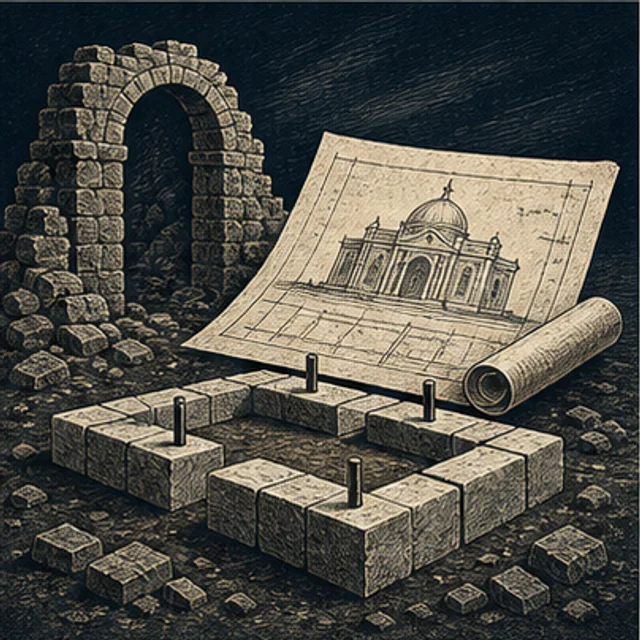
Core Critic Claim
No archaeological evidence confirms Book of Mormon civilizations, cities, or artifacts: therefore the Book of Mormon is not historical.
Key Defensive Points
- Absence of evidence is not evidence of absence. Hittites, House of David, Belshazzar, and the pool of Bethesda were all considered unhistorical until archaeology confirmed them.
- Major biblical narratives also lack archaeological confirmation. The Exodus, the Patriarchs, Noah’s Flood, and the Tower of Babel have no direct archaeological evidence. This does not disprove the Bible.
- Mesoamerican archaeology is young and incomplete. Serious work began mid-20th century. Maya script was deciphered only in the 1980s-90s. 2018 LiDAR surveys in Guatemala revealed 60,000+ previously unknown structures.
- Spanish conquest destroyed indigenous records. Bishop Diego de Landa burned virtually all Maya codices in 1562. Only four survive.
- The limited geography model constrains expectations. Book of Mormon events likely occurred in a small area among a small population: not across the entire Western Hemisphere.
- Convergent evidence exists (not proof, but noteworthy). Nahom (NHM altars in Yemen), cement construction, chiasmus, Hebraisms, pre-Columbian barley.
Key Scriptures
| Scripture | Point |
|---|
| Hebrews 11:1 | ”Faith is the substance of things hoped for, the evidence of things not seen” |
| Moroni 10:3-5 | The Book of Mormon’s own test: spiritual witness through the Holy Ghost |
| Alma 32:17-21 | Faith is belief in things “not seen, which are true” |
| Ether 12:6 | ”Ye receive no witness until after the trial of your faith” |
| 2 Corinthians 5:7 | ”We walk by faith, not by sight” |
| 1 Nephi 16:34 | Nahom: potential Old World correlation with NHM altars |
| Helaman 3:7-11 | Cement construction: confirmed Mesoamerican practice |
One-Line Objection Responses
| Objection | Response |
|---|
| ”The Smithsonian says it’s not historical.” | The Smithsonian has never conducted a systematic study of Book of Mormon claims; its form letter reflects methodological neutrality, not a considered verdict. |
| ”If it’s true, evidence should be everywhere.” | That assumes the abandoned hemispheric model; the limited geography model expects evidence in a small, constrained area. |
| ”DNA disproves Israelite migration.” | A small founding population absorbed into a larger indigenous population would leave no detectable genetic signal after thousands of years. |
| ”Horses, steel, and wheat are anachronisms.” | Loan-shifting (familiar English words for unfamiliar items); pre-Columbian barley has since been found; Hittites were once considered anachronistic too. |
| ”Biblical archaeology has mountains of evidence.” | After 200+ years of intensive research in well-preserved regions: and the Exodus, Patriarchs, and Conquest still lack confirmation. |
| ”We would have found Nephite cities by now.” | 2018 LiDAR revealed 60,000+ unknown structures in Guatemala alone; the assumption of completeness is demonstrably false. |
| ”No Reformed Egyptian has ever been found.” | Most ancient scripts were unknown until discovered (Linear A/B, Maya glyphs, Elamite); absence of discovery is not proof of non-existence. |
Quick Evidence Points
| Item | Detail |
|---|
| Nahom (NHM) | Votive altars with NHM tribal name found in Yemen, 7th-6th century BC, matching 1 Nephi 16:34 |
| Cement | Helaman 3:7-11 describes cement; confirmed in Mesoamerican construction (Maya, Teotihuacan) |
| Chiasmus | Complex Hebrew literary structure identified throughout Book of Mormon (John W. Welch, 1969) |
| Hebraisms | Cognate accusatives, if/and conditionals, construct chains consistent with ancient Near Eastern authorship |
| Barley | Pre-Columbian Hordeum pusillum found at archaeological sites; once considered an anachronism |
| Large populations | LiDAR confirms Mesoamerican populations far larger than previously estimated: consistent with Book of Mormon scale |
Biblical Parallels: Claims Once Denied, Later Confirmed
| Biblical Claim | Confirmed By | Year |
|---|
| Hittites | Hattusa excavation | 1906 |
| House of David | Tel Dan Stele | 1993 |
| Pontius Pilate | Pilate Stone, Caesarea Maritima | 1961 |
| Pool of Bethesda | Excavation, Jerusalem | 19th c. |
| Belshazzar | Nabonidus Cylinder | 1854 |
Essential Links
Introduction
One of the most frequently raised objections to the Book of Mormon is the claim that it lacks archaeological confirmation. Critics argue that while the Bible has been supported by extensive archaeological discoveries: cities, inscriptions, artifacts, and ruins: the Book of Mormon has no comparable evidentiary base. No Nephite city has been excavated. No Lamanite inscription has been found. No artifact bearing Book of Mormon names has been unearthed. This document engages the strongest version of this criticism, examines the state of the evidence honestly, and presents the Latter-day Saint response with scholarly rigor.
The Criticism (Steelmanned)
The critic’s case is straightforward and powerful:
-
No confirmed Book of Mormon site: Despite nearly 200 years since the Book of Mormon’s publication, no archaeological site in the Americas has been definitively identified as a Book of Mormon location. Zarahemla, Bountiful, the land of Nephi: none have been located.
-
No inscriptions or artifacts: No artifact bearing Book of Mormon names, Reformed Egyptian script, or identifiable Nephite/Lamanite cultural markers has been found. By contrast, the Bible has been confirmed by thousands of inscriptions, seals, and artifacts (e.g., the Tel Dan Stele, the Pilate inscription, the Hezekiah tunnel inscription).
-
No professional consensus: Mainstream (non-LDS) archaeologists and Mesoamericanists do not regard the Book of Mormon as a historical document. The Smithsonian Institution has repeatedly stated it does not use the Book of Mormon as a guide to archaeological research.
-
The DNA challenge: Genetic studies of indigenous American populations show primary descent from Asian populations via the Bering land bridge, not from Near Eastern populations. This appears to contradict the Book of Mormon’s account of Israelite migrations to the Americas.
-
Anachronisms: The Book of Mormon mentions items: horses, steel, wheat, barley, chariots, elephants: that mainstream archaeology holds were absent from the pre-Columbian Americas (or absent in the relevant time periods).
-
The contrast with the Bible: Biblical archaeology is a robust academic discipline with centuries of confirmed discoveries. The absence of comparable evidence for the Book of Mormon, despite extensive searching, is taken as strong evidence of non-historicity.
This is a genuinely serious challenge. The evidentiary asymmetry between biblical and Book of Mormon archaeology is real and must be addressed honestly.
Biblical Response
Biblical Archaeology Was Not Always Confirmatory
The assumption that biblical archaeology straightforwardly confirms the Bible is historically naive. For centuries, critics denied the existence of numerous biblical peoples, places, and persons: until archaeology eventually confirmed them:
- The Hittites: For much of the 19th century, the Hittites (mentioned over 40 times in the Old Testament) were considered fictional. No extrabiblical evidence for them existed. The discovery of the Hittite capital at Hattusa in 1906 reversed this consensus entirely.
- The House of David: Until the Tel Dan Stele was discovered in 1993, many scholars questioned whether David was a historical figure. The inscription “House of David” (bytdwd) was the first extrabiblical reference to David.
- Pontius Pilate: The Pilate Stone, discovered at Caesarea Maritima in 1961, provided the first archaeological confirmation of Pilate’s existence outside the New Testament and Josephus.
- The pool of Bethesda: John 5:2 describes a pool with “five porches.” Critics long argued this was theologically symbolic, not historical. Excavations in the 19th century revealed a pool with precisely this structure.
- Belshazzar: Daniel 5 names Belshazzar as king of Babylon. For centuries, only Nabonidus was known as the last Babylonian king. The Nabonidus Cylinder, discovered in 1854, confirmed Belshazzar as Nabonidus’s co-regent.
The principle: Absence of evidence is not evidence of absence. Many biblical claims were considered archaeologically unsubstantiated for centuries before confirmatory evidence was found. The current state of Book of Mormon archaeology may represent an early stage of a similar process.
The Bible Contains Its Own Unresolved Archaeological Questions
Even with centuries of archaeological research, significant biblical claims remain archaeologically unconfirmed:
- The Exodus: There is no direct archaeological evidence for the Israelite Exodus from Egypt, the wandering in Sinai, or the conquest of Canaan as described in Joshua. Prominent archaeologists (Israel Finkelstein, William Dever) regard the Exodus account as historically problematic. Yet few critics argue this disproves the Bible entirely.
- The Patriarchs: There is no archaeological evidence for Abraham, Isaac, or Jacob as historical individuals. Their historicity is debated among biblical scholars.
- Noah’s Ark and the Flood: No archaeological or geological evidence confirms a global flood. Most scholars treat the Genesis flood account as mythological or local.
- The Tower of Babel: No confirmed archaeological identification exists.
If lack of archaeological evidence disproves the Book of Mormon, consistency requires the same standard be applied to these biblical narratives. Most critics are unwilling to accept that implication.
Scripture Does Not Condition Its Authority on Archaeological Confirmation
Nowhere in the Bible does God promise that archaeological evidence will confirm His word. Faith is described as “the substance of things hoped for, the evidence of things not seen” (Hebrews 11:1). The evidential basis for scriptural truth in biblical theology is spiritual witness, prophetic testimony, and the fruits of obedience: not material artifacts.
Early Christian/Historical Evidence
Ancient Records Routinely Disappear
The historical record is far more fragmentary than modern assumptions suggest:
- The vast majority of ancient texts are lost. Scholars estimate that less than 1% of ancient Greek and Roman literature has survived. Entire civilizations have left minimal material traces.
- Mesoamerican destruction: The Spanish conquest systematically destroyed indigenous records. Bishop Diego de Landa burned virtually all Maya codices in 1562. Only four Maya codices survive. An entire civilization’s literary heritage was deliberately obliterated. If the Nephite record tradition existed, the likelihood of its survival through such destruction is negligible.
- Perishable materials: Many ancient cultures wrote on materials (bark paper, animal skins, wood) that do not survive in tropical climates. The archaeological record is inherently biased toward durable materials (stone, clay) and arid climates.
Mesoamerican Archaeology Is a Young Discipline
- Serious archaeological work in Mesoamerica began only in the mid-20th century. The Maya script was not deciphered until the 1980s-1990s. Vast areas of Mesoamerica remain unexcavated. The claim that “no evidence exists” must be qualified by the recognition that the search has barely begun relative to biblical archaeology, which has been conducted intensively for over 200 years.
- Major discoveries continue to reshape understanding. LiDAR surveys in Guatemala (published 2018) revealed over 60,000 previously unknown structures, dramatically expanding estimates of Maya population density and demonstrating that current archaeological knowledge represents a fraction of what existed.
Points of Convergence (Not Proof, but Noteworthy)
While no confirmed Book of Mormon site exists, several features of the Book of Mormon text align with what has subsequently been learned about the ancient world:
- Nahom (1 Nephi 16:34): The tribal name NHM has been found on votive altars in Yemen dating to the 7th-6th centuries BC, in the general area where the Book of Mormon places Nahom. This is the most frequently cited candidate for an Old World Book of Mormon geographical correlation.
- Cement construction (Helaman 3:7-11): The Book of Mormon describes cement being used in construction in the land northward. Mesoamerican archaeology has confirmed extensive use of cement in ancient construction, notably among the Maya and at Teotihuacan.
- Complex civilization: The Book of Mormon describes large populations, cities, temples, literacy, organized warfare, and complex political structures. Mesoamerican archaeology has confirmed all of these features in the relevant time periods.
- Barley: Once considered an anachronism, pre-Columbian barley (Hordeum pusillum) has been identified at archaeological sites in the Americas.
- Hebraisms in the text: Numerous Hebrew literary structures: chiasmus, cognate accusatives, construct chains, if/and conditionals: have been identified in the Book of Mormon text by scholars such as John W. Welch and Donald W. Parry. These are consistent with an ancient Near Eastern origin.
LDS Doctrinal Position
The Book of Mormon’s Own Evidentiary Framework
The Book of Mormon itself does not promise archaeological verification. It promises spiritual confirmation:
- Moroni 10:3-5: “When ye shall receive these things, I would exhort you that ye would ask God, the Eternal Father, in the name of Christ, if these things are not true; and if ye shall ask with a sincere heart, with real intent, having faith in Christ, he will manifest the truth of it unto you, by the power of the Holy Ghost.”
- The Book of Mormon title page: States the book’s purpose is “the convincing of the Jew and Gentile that Jesus is the Christ”: a spiritual purpose, not an archaeological one.
The Limited Geography Model
Modern Latter-day Saint scholarship has largely moved away from the hemispheric geography model (which imagined Nephites and Lamanites spanning all of North and South America) toward a limited geography model. This model places Book of Mormon events in a geographically small area: likely in Mesoamerica or another constrained region: and envisions the Nephite and Lamanite populations as coexisting with larger indigenous populations. Under this model:
- The difficulty of identifying specific Book of Mormon sites is expected, given the small scale and the limitations of the archaeological record.
- The DNA challenge is mitigated, as a small Israelite founding population would be genetically swamped by the larger indigenous population over time, leaving no detectable genetic signal (see Book of Mormon and DNA Studies: Gospel Topics Essay).
- Anachronisms may reflect translation choices (loan-shifting) rather than actual presence of the named items.
Faith and Evidence in LDS Theology
Latter-day Saint theology affirms that faith requires agency and cannot be compelled by irrefutable proof:
- Alma 32:17-21: “If a man knoweth a thing he hath no cause to believe, for he knoweth it… faith is not to have a perfect knowledge of things; therefore if ye have faith ye hope for things which are not seen, which are true.”
- Ether 12:6: “Faith is things which are hoped for and not seen; wherefore, dispute not because ye see not, for ye receive no witness until after the trial of your faith.”
The absence of conclusive archaeological proof may be consistent with God’s purposes rather than contradictory to them.
Key Scriptures
- Hebrews 11:1: “Faith is the substance of things hoped for, the evidence of things not seen”
- Moroni 10:3-5: The Book of Mormon’s own evidentiary test: spiritual witness through the Holy Ghost
- Alma 32:17-21: Faith as belief in things “not seen, which are true”
- Ether 12:6: “Ye receive no witness until after the trial of your faith”
- 2 Corinthians 5:7: “We walk by faith, not by sight”
- 1 Nephi 16:34: Nahom reference; potential Old World correlation
- Helaman 3:7-11: Cement construction; confirmed Mesoamerican practice
- 2 Nephi 27:14: God will do His “own work” in bringing forth truth
Responses to Common Objections
”The Smithsonian says the Book of Mormon has no archaeological support.”
The Smithsonian Institution has issued form letters stating it does not use the Book of Mormon as a scientific guide. This is true. However, the Smithsonian has not conducted a systematic study aimed at testing Book of Mormon claims. The institution’s statement reflects methodological neutrality, not a considered verdict. No mainstream archaeological institution has conducted systematic research specifically designed to test Book of Mormon historicity. The absence of a verdict is not the same as a negative verdict.
”If the Book of Mormon is true, there should be evidence everywhere.”
This assumes the hemispheric geography model, which most Latter-day Saint scholars have abandoned. Under the limited geography model, Book of Mormon events took place in a geographically constrained area among a relatively small population. The expectation that evidence should be “everywhere” is based on a reading of the text that even LDS scholars no longer endorse.
”DNA evidence disproves Israelite migration to the Americas.”
The Church’s Gospel Topics Essay on this subject explains that population genetics cannot reliably detect a small founding population absorbed into a much larger existing population over thousands of years. Genetic drift, bottleneck effects, and the founder effect would eliminate detectable Near Eastern DNA signatures from a small migrating group within a few generations. The DNA argument assumes what it needs to prove: that the Book of Mormon describes the sole or primary ancestry of all indigenous Americans. The text itself does not make this claim. See Book of Mormon and DNA Studies.
”Horses, steel, and wheat are anachronisms that disprove the text.”
Several responses are relevant:
- Loan-shifting: Joseph Smith may have used familiar English terms for unfamiliar ancient items. “Horse” may refer to a different animal (deer, tapir); “steel” may refer to hardened copper or obsidian-edged weapons; “wheat” may refer to a related grain.
- Pre-Columbian barley: Once considered an anachronism, domesticated barley (Hordeum pusillum) has been found at pre-Columbian sites.
- Pre-Columbian horses: There is ongoing debate about the extinction timeline of horses in the Americas. Some evidence suggests horses may have survived later than the conventional 10,000 BC extinction date.
- The Hittite principle: Absence of evidence is not evidence of absence. Many biblical claims were considered anachronistic until confirmed by later discoveries.
”Biblical archaeology has mountains of evidence. The Book of Mormon has none.”
The comparison is misleading. Biblical archaeology has been conducted intensively for over 200 years across well-documented, well-excavated regions. Mesoamerican archaeology is far younger, covers vast areas that remain unexcavated, and contends with tropical climates that destroy organic materials and Spanish conquest that destroyed indigenous records. Also, many major biblical claims (the Exodus, the Patriarchs, the Conquest of Canaan) remain archaeologically unconfirmed. The evidentiary gap is real but is partly a function of the asymmetry in research intensity and preservation conditions.
”If there were Nephite civilizations, we would have found them by now.”
The 2018 LiDAR discoveries in Guatemala revealed over 60,000 previously unknown ancient structures hidden beneath jungle canopy: structures that had been invisible to archaeologists for decades. The assumption that Mesoamerican archaeology is substantially complete is demonstrably false. Vast areas remain unexplored, and new technologies continue to reveal previously unknown features of ancient American civilizations.
Conclusion
The lack of a securely identified Book of Mormon site is a significant challenge for a historical reading of the text. Proposed correspondences such as Nahom, cement, literary structures, and possible language patterns are debated and do not amount to archaeological confirmation. The uncertainty also cuts the other way: limited geography, an incomplete record, and unsettled location proposals make sweeping claims of disproof difficult to sustain. The result is not an archaeological victory for either side. It is a reason to state what has and has not been established, then consider the book’s textual, spiritual, and historical claims without pretending that one kind of evidence can do all the work.
Further Reading: