
Figure 1
- Egyptian reading
- Osiris on his throne in the afterlife. The crown and crook fit that role. Ritner reads the adjacent text as an address by Osiris, with some signs uncertain.
- Ritner, p. 114
The 1842 explanations place Abraham in Pharaoh’s court. Egyptologists read the scene as the deceased Hor before Osiris. The written labels for Pharaoh and Shulem are especially important because Egyptologists read them as Isis and Hor. Some signs are hard to make out in the engraving, and the original vignette is missing.
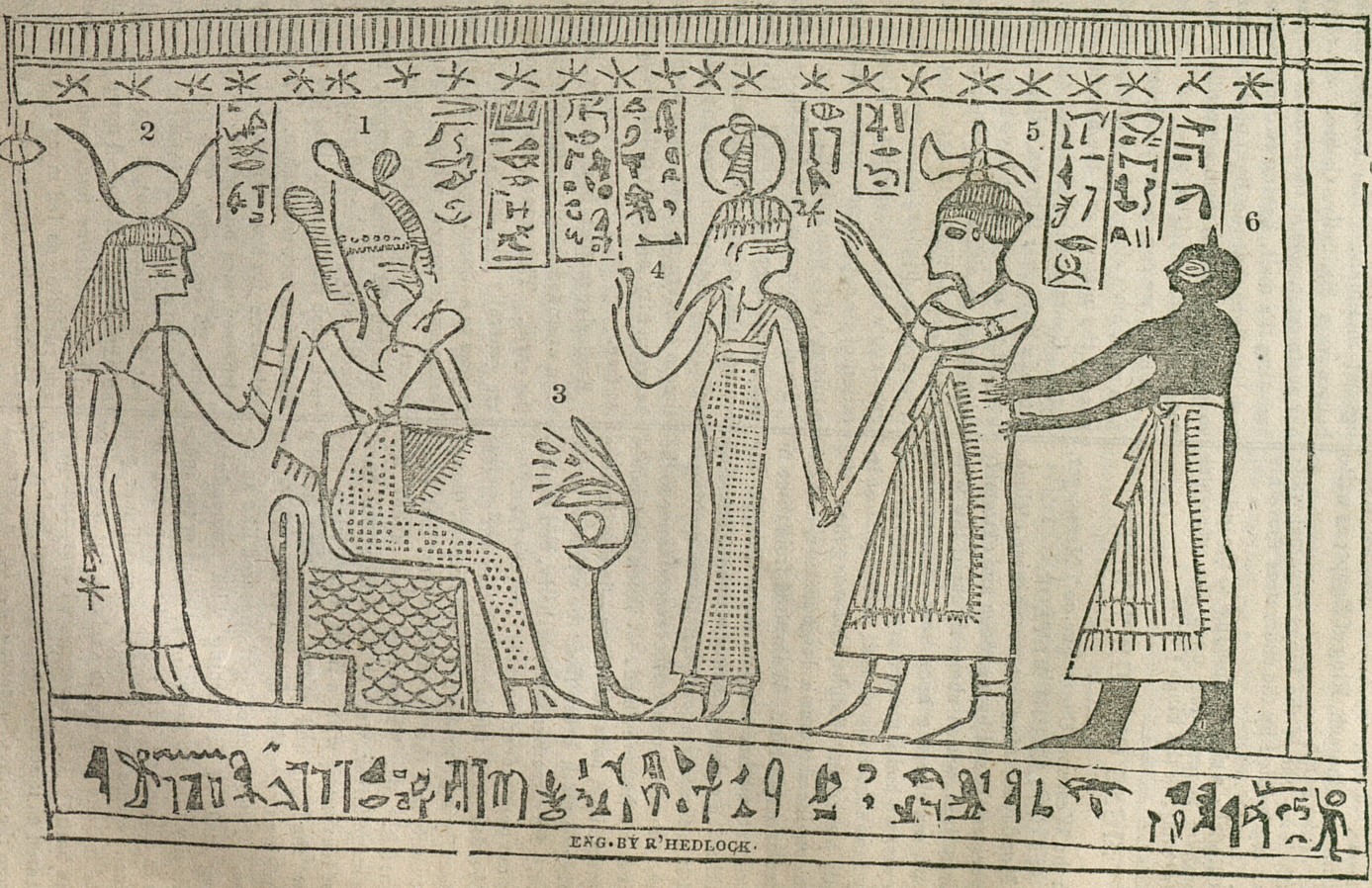
In the Egyptian scene, the deceased Hor is presented before Osiris. The 1842 explanation presents Abraham in Pharaoh’s court. The clearest differences are the written labels. Egyptologists read figure 2 as Isis and figure 5 as Hor. The explanations identify them as Pharaoh and Shulem. The original vignette is missing, and some signs in the engraving are hard to read. Compare the six figures
“The Egyptian reading gives us a real problem if the explanations are meant as literal translations. An Egyptian image could be used to illustrate a revealed Abraham story. I’d still want to account for why the explanations point readers to specific characters for the names.”
The Times and Seasons published Facsimile 3 on May 16, 1842. The engraving appeared on page 783 and its explanations on page 784. The original Egyptian vignette is missing. Scholars work from the engraving and from comparable Egyptian scenes and inscriptions. 1842 engraving · Original explanations
The figure seated on the throne is ordinarily identified as Osiris. An offering stand is in front of him. Maat and a figure usually identified as Anubis accompany Hor, the deceased owner of the papyrus. The bottom inscription names Hor. This fits the image’s position at the end of his Book of Breathings. Ritner relates it to the Egyptian judgment tradition. Smoot and colleagues describe it as an afterlife presentation and distinguish it from scenes that show the weighing of the heart. The engraving shows no scales. Ritner, pp. 113–15 · Smoot and colleagues on the presentation scene
The 1842 explanation describes Abraham in Pharaoh’s court. Figure 1 is Abraham on the throne. Figure 3 signifies Abraham in Egypt. Figure 4 is a prince, and figure 6 is Olimlah, a slave belonging to the prince. The comparison pairs those explanations with the Egyptian readings. The CES Letter and Stephen E. Thompson both use the differences to challenge the explanations. Compare the six figures · CES Letter · Thompson in Dialogue
The 1842 explanation identifies King Pharaoh and says his name is written above his head. Robert Ritner and Michael Rhodes both read that label as naming Isis and describing her as the god’s mother. Smoot and colleagues compare Rhodes’s reconstruction with the engraving and point out that the signs for the name are especially difficult to make out. The Isis reading draws on the damaged copy and parallels with other Egyptian scenes. Original caption · The two Egyptological readings and the signs
Isis’s association with Egyptian kingship offers a reason her image could represent a ruler in another setting. That interpretation still needs to account for the wording about the name written above the figure. An association between Isis and kingship cannot establish the name of a human king in these particular signs. Smoot and colleagues, “Isis the Pharaoh”
The explanation calls the man Shulem, one of the king’s attendants, and points to the characters above his hand. Ritner reads the label as identifying Hor and describing him as justified forever. Hor’s name also appears in the inscription below the scene. The signs above the hand are irregular in the engraving, so the lower inscription and the funerary context matter when assessing the identification. Original caption · Ritner, pp. 114–15 · Facsimile commentary, figure 5
Smoot and colleagues report that Shulem is an attested Semitic name. That makes the name plausible in a story set in Abraham’s world. A reading of the Egyptian caption would still need to show where the signs give that name. Facsimile commentary, figure 5
The Egyptian readings give a direct reason to reject the claim that the explanations match an ordinary translation of these captions. A proposal about missing papyri can address where the English narrative came from. It leaves the printed explanations and their references to visible characters available for comparison. Church essay on translation and historicity
A Latter-day Saint can consider whether Joseph used an Egyptian scene to illustrate a revealed Abraham narrative. Abraham 3 already places his teaching about the heavens in the context of a journey to Egypt. Reusing an image could account for different people or roles in the two readings. The language about names written in specific characters is the harder part of that explanation. We can acknowledge that difficulty while evaluating the scripture’s claims about God, creation, and covenant on their own evidence. Abraham 3:15 · The broader papyri and translation case