Was the 1832 First Vision account cut out and hidden?
The short answer
The three history leaves were cut from Letterbook 1, and access was limited before wider circulation in the 1960s. The evidence is less certain about who ordered removal and why. Publication in 1969 and 1970 does not prove earlier openness. The leaves were still detached in 1984 and apparently reattached in the 1990s. A faithful response should acknowledge the access history and distinguish fact from competing explanations.
Questions that test the framework
Which evidence establishes the removal, and which supports the proposed person and motive?
Are we discussing research access, publication, member familiarity, or physical reattachment?
What does later disclosure establish about earlier restrictions, and what evidence would establish knowing deception?
Were the Pages Really Cut Out?
Yes. The Joseph Smith Papers identifies three history leaves removed from Letterbook 1. The physical evidence does not name the cutter or establish the motive. The Church FAQ offers archival reorganization as a possibility, rather than a documented instruction for this removal.
Was Access Limited?
The account was not widely available before the 1960s. Stan Larson’s historical reconstruction discusses reported permission requirements and refused access. Those reports deserve examination; his attribution of the removal and its purpose includes inference. No confession is required for historical inference, but it must be distinguished from the physical evidence.
When Was It Published and Reattached?
Cheesman’s thesis dates to 1965; Jessee published the accounts in 1969, and Allen discussed them in the Church’s magazine in 1970. The leaves were still detached in 1984 and apparently reattached in the 1990s. Publication, availability with the collection, and physical reattachment are separate events.
Does the 1970 Article Prove Nothing Was Ever Hidden?
No. It proves disclosure at that time, rather than universal openness beforehand. Ballard cited that article in his 2017 remarks reported by Church News. The custody sources here do not establish whether he knowingly misstated earlier events.
A Reply You Can Use
“The cut pages and limited access deserve a candid account. Who ordered the removal and why are less certain than the removal itself. I believe the First Vision, support open access to its records, and would correct both a mistaken reattachment date and an overbroad claim of uninterrupted transparency.”
The Short Answer
The three leaves containing Joseph Smith’s 1832 history were cut from Letterbook 1, and access to the account was limited before its circulation in the 1960s. That history deserves a direct answer. The evidence is less certain about who ordered the cutting and why. A proposal that archivists reorganized the material is not a demonstrated explanation; neither is every detail of a deliberate-suppression account established fact.
Publication in 1969 and 1970 shows that the account was being disclosed then. It does not prove that access had always been open. The physical history also corrects one particular claim: the leaves were still detached in 1984 and were apparently reattached in the 1990s, rather than taped back into the book in the mid-1960s.
Which Question Are We Answering?
This case concerns the account’s later custody and use. For differences between Joseph’s own narratives, see the First Vision accounts comparison. For what Church lessons included, see the curriculum comparison. An argument about a twentieth-century archivist’s conduct is distinct from an argument about what Joseph experienced in 1820. Both can matter to trust, but one does not settle the other automatically.
Follow the Record
1832: Joseph records the history in a book later used for letters
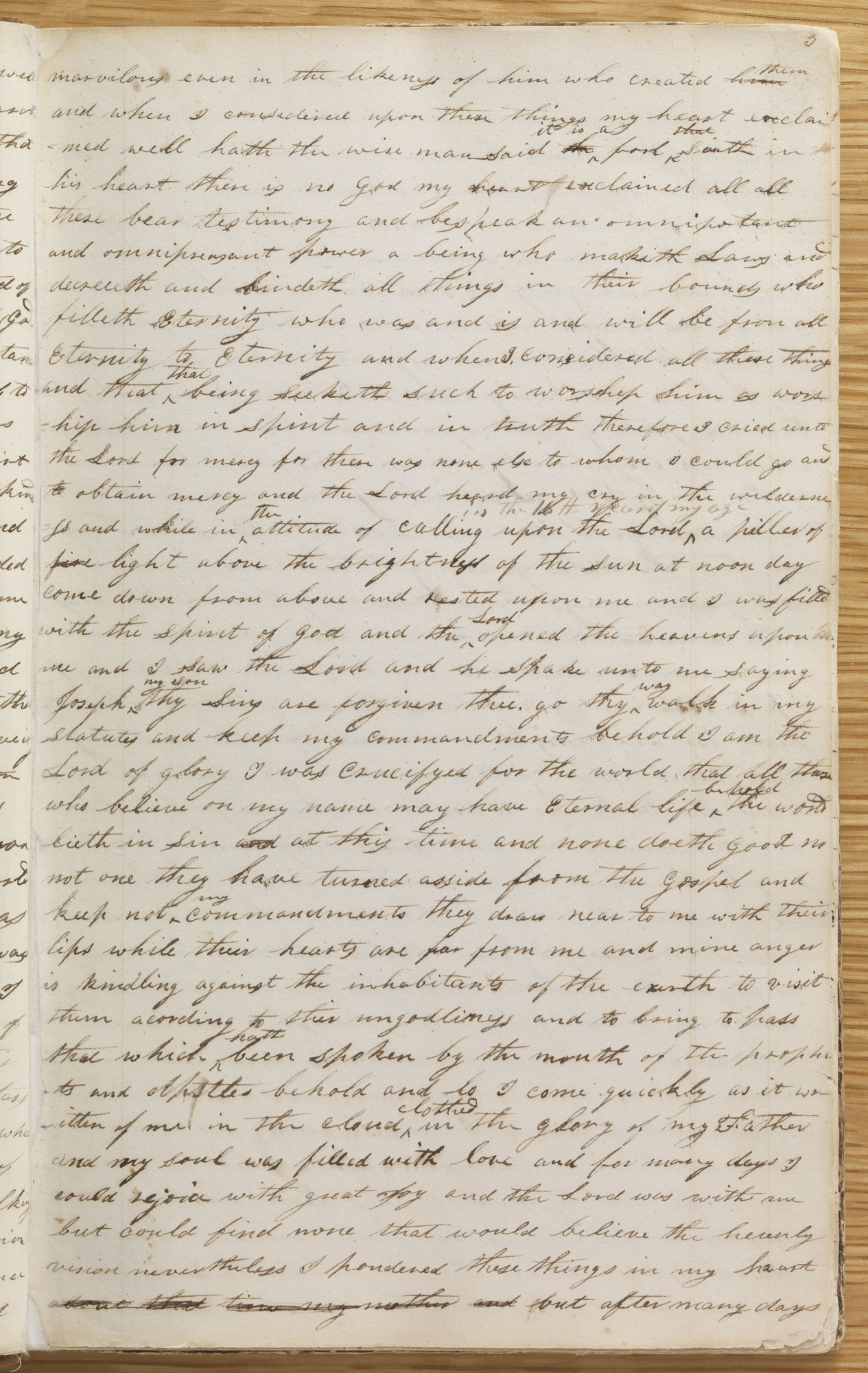
The Joseph Smith Papers source note identifies six pages on three leaves, in Joseph Smith's and Frederick G. Williams's handwriting. The book was subsequently used to copy letters. Its history section includes the earliest surviving firsthand written account of the First Vision.
Page 3, in Joseph Smith's handwriting. This is the document's conserved state. The image shows the narrative; it does not itself date the excision or identify who ordered it.
Mid-twentieth century: the history leaves are removed
The physical evidence includes matching paper, gutter inscriptions, and cut and tear marks. The source note places the excision in the mid-twentieth century and says the leaves had certainly been cut out by 1965. It describes them as archived together with the letterbook.
The Church's 2022 FAQ gives a 1930–1965 range. The early boundary is connected with cellophane tape used to repair a tear, and the inference that repair occurred near the excision. It is not a dated order to cut the pages. The source note does not identify a cutter or a motive.
1950s and 1960s: reports of controlled access become important
In his 2014 historical article, Stan Larson presents LaMar Petersen's notes of a 1953 conversation with Levi Edgar Young, alongside Petersen's later recollection. The reported encounter describes permission to inspect a “strange” account and restrictions on copying or discussing it. Larson also recounts the Tanners' unsuccessful request for access in 1964.
This is meaningful evidence for investigating limited access. Identify the chain: Petersen recorded Young's description, and Larson later published and interpreted it. The later recollection is not a contemporary order signed by Joseph Fielding Smith. Larson himself distinguishes the uncertain reasoning from his inference about senior staff and discomfort with the account's contents.
1965, 1969, and 1970: the account enters wider circulation
The BYU repository identifies Paul R. Cheesman's 1965 thesis. The Joseph Smith Papers cites its appendix in describing the cut leaves. Larson recounts the Tanners' subsequent publication using Cheesman's transcript. These are different stages of circulation, not a single moment when every member learned the story.
Dean C. Jessee published the early accounts in BYU Studies in 1969; a later BYU reprint is available here. James B. Allen discussed them in the April 1970 Improvement Era. These publications are evidence against a claim that the account was never disclosed. They do not establish how accessible it had been in earlier decades or how widely it was later taught.
1984 to the 1990s: publication and physical reattachment remain different events
The Joseph Smith Papers reports that the leaves were still detached when photographed for a 1984 publication. Images made by 2000 show reattachment, and an archival register places that restoration in the 1990s.
This corrects the statement in RFM's 2017 episode transcript, printed pages 9–10, that Joseph Fielding Smith taped the leaves back into the book before Cheesman's work. Making material available with the collection is not the same as physically rebinding it. The Church FAQ's description of an early-1960s reunion should not be treated as evidence of reattachment then.
Correcting that date does not disprove restricted access or settle motive. It corrects one part of the proposed sequence.
What Explains the Removal?
Proposed conclusion
Evidence and limits
The pages were cut from this book.
Physical matches and documentary descriptions establish removal. This is not merely a critical allegation.
Joseph Fielding Smith personally cut them out to suppress the account.
Larson infers involvement by Smith or senior staff from custody and access history. The surviving physical evidence alone supplies neither a named cutter nor an instruction explaining intent.
Archivists removed the history to organize records by topic.
The Church FAQ offers this as a possible archival explanation. A possible practice does not establish that it caused this particular removal.
Later publication proves there was never concealment.
Disclosure at a later date does not determine earlier access policy or intent. Conversely, limited access does not by itself establish every claim about deliberate suppression.
Circumstantial evidence can support a motive without a confession. The right questions are who controlled access, what requests were made and refused, what permission was granted, and how strongly the pattern favors each explanation. Existing institutional custody does not by itself rule out a further restriction within the institution. Neither should the lack of general publication be treated as proof of a particular person’s state of mind.
What About Ballard’s 2017 Assurance?
The contemporary Church News report records M. Russell Ballard responding to criticism about differing First Vision accounts. He cited Allen’s 1970 article and said “there has been no attempt on the part of the Church leaders to try to hide anything from anybody.” The official recording identifies the November 19 event.
The 1970 publication supports the narrower point that the accounts had appeared in Church publications decades before the broadcast. It cannot establish a universal claim that no leader ever tried to conceal historical information. I would not defend that universal assurance merely by pointing to a later article.
A further accusation of deliberate lying requires evidence about what Ballard knew and intended. The publication and custody sources here do not establish his state of mind. An overbroad assurance, a disputed historical interpretation, and a knowingly false statement are not interchangeable findings. This page examines one historical case, not every example in RFM’s larger episode.
A Believing Response
I believe Joseph’s First Vision was real. That belief does not require defending every later archival decision or assuring readers that access was always open. The 1832 account remains an early document partly in Joseph’s own handwriting, and its differing wording deserves examination. Later custodians’ conduct does not automatically determine the truth of the experience it records.
Restricted access and inadequate disclosure can still reasonably affect trust in institutional storytelling. The constructive response is to make the records available, correct errors in both apologetic and critical timelines, and explain what is known. “It is online now” is a welcome fact, not a complete answer to a question about earlier access.
I would say: “Yes, the leaves were removed and access was limited. I will not turn a proposed archival explanation into a proven fact, or treat the physical evidence as proof of a particular person’s motive. The account was circulating by the 1960s and publicly discussed in 1969 and 1970, but the leaves were not physically reattached until much later. I believe the First Vision and support candid access to all its surviving accounts.”
This case checks the document, custody reconstruction, publication, conservation chronology, and the limits of the competing inferences. The wider question of prophetic reliability is discussed in prophets and fallibility.